CNC Wire Bending Machine vs. Hydraulic Bending Machine: Which Is Right for Your Production?
Choosing the right bending equipment is essential for manufacturers looking to improve production efficiency, product quality, and operating costs. Today, CNC wire bending machines and hydraulic bending machines are widely used for different types of metal forming and bending applications.
While both technologies are designed to form metal, they differ significantly in terms of automation, precision, flexibility, bending force, and production efficiency.
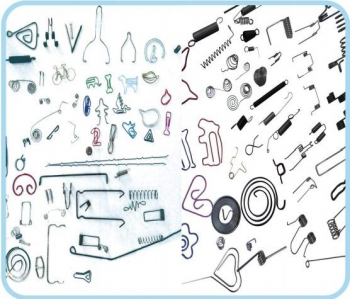
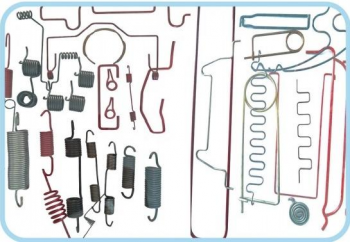
For manufacturers producing wire forms, springs, brackets, clips, and other precision components, a CNC wire bending machine can provide excellent repeatability and production flexibility. Hydraulic bending machines, meanwhile, are well suited to heavy-duty applications involving thick and rigid materials.
In this guide, we compare CNC wire bending machines and hydraulic bending machines, explain their key advantages and applications, and provide practical guidance for selecting the right solution for your production requirements.
What Is a CNC Wire Bending Machine?
A CNC wire bending machine is an automated forming machine that uses computer numerical control technology to bend wire or metal material according to programmed specifications.
Parameters such as bending angle, position, speed, and bending sequence can be programmed into the control system. Once the machine has been set up, it can repeatedly produce components with consistent dimensions and shapes while reducing manual intervention.
CNC wire bending technology is particularly suitable for manufacturers that require:
High production accuracy
Excellent repeatability
Complex wire shapes
Automated production
Multiple product specifications
Fast product changeovers
High production efficiency
Compared with conventional manual or semi-automatic equipment, CNC technology gives manufacturers greater control over the forming process.
Types of CNC Wire Bending Machines
Different products require different forming capabilities. Two common solutions are 3D CNC wire bending machines and 2D wire bending machines.
3D CNC Wire Bending Machine
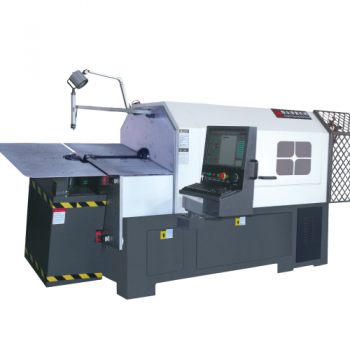
A 3D CNC wire bending machine is designed to produce three-dimensional wire forms with multiple bending directions.
It can be used to manufacture products such as:
Automotive wire components
Wire brackets
Frames
Supports
Clips
Complex three-dimensional wire forms
The ability to perform multiple bending operations in an automated production cycle makes 3D CNC wire bending machines suitable for complex components and demanding production requirements.
2D Wire Bending Machine
A 2D wire bending machine primarily forms wire within a two-dimensional plane.
It is suitable for relatively simple products such as frames, clips, supports, and other wire components with straightforward bending requirements.
For manufacturers producing large quantities of standardized wire products, a 2D wire bending machine can provide an effective combination of speed, accuracy, and production efficiency.
What Are the Advantages of a CNC Wire Bending Machine?
High Precision and Repeatability
CNC control allows bending parameters to be programmed accurately, helping manufacturers maintain consistent product dimensions throughout production.
This is especially important for industries where component accuracy and repeatability are critical.
High Production Efficiency
Automated feeding and bending processes can reduce manual operations and improve production efficiency.
For high-volume manufacturing, automation can help increase output while maintaining consistent product quality.
Flexible Production
CNC programs can be changed for different products and specifications. This makes CNC wire bending machines particularly useful for manufacturers producing multiple product models.
Complex Wire Forming
A CNC wire forming machine can produce complex shapes that would be difficult or time-consuming to manufacture manually.
Depending on the machine configuration, multiple forming operations can be integrated into one automated process.
Reduced Operator Dependency
Automation reduces the amount of manual intervention required during production. This can help minimize operator-related errors and improve production consistency.
What Is a Hydraulic Bending Machine?
A hydraulic bending machine uses hydraulic pressure to generate the force required to bend metal.
The system typically consists of hydraulic pumps, valves, cylinders, and a ram. Hydraulic pressure moves the ram and applies force to the workpiece.
Hydraulic bending machines are commonly used for heavy-duty applications involving thick metal plates and rigid materials.
Typical applications include:
Steel fabrication
Heavy machinery manufacturing
Construction
Structural components
Shipbuilding
Large metal fabrication projects
Hydraulic Bending Machine Advantages
High Bending Force
The main advantage of hydraulic technology is its ability to generate substantial force.
This makes hydraulic bending machines suitable for thick steel plates and large metal components that require significant forming force.
Robust Construction
Hydraulic machines are generally designed for demanding industrial environments and heavy-duty applications.
Simple Operation
Hydraulic bending equipment can be suitable for applications with relatively standardized production requirements and less need for frequent programming changes.
Lower Initial Investment
Depending on the machine configuration and application, hydraulic equipment may offer a lower initial investment than advanced CNC automation systems.
CNC Wire Bending Machine vs. Hydraulic Bending Machine
The main difference between CNC and hydraulic bending technology is not simply which machine is more powerful. The key consideration is what type of production you need to achieve.
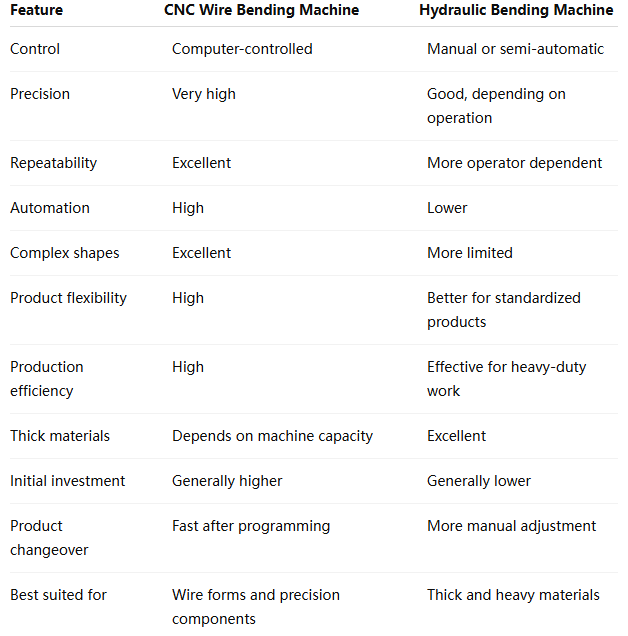
The original comparison supports the same overall conclusion: CNC machines are strongest in automated, high-precision, flexible applications, while hydraulic machines are better suited to heavy-duty bending where force and simplicity are priorities.
CNC Wire Bending Machine Applications
A CNC wire bending machine can be used across a wide range of manufacturing industries.
Automotive
CNC wire forming equipment can be used to produce brackets, supports, frames, clips, and other wire-formed components.
Electronics
Precision wire bending is suitable for smaller components requiring accurate and repeatable shapes.
Aerospace
CNC-controlled forming equipment can be used for components requiring complex geometries and consistent dimensions.
General Manufacturing
Manufacturers can use CNC wire bending machines to produce different types of wire products while maintaining production flexibility.
Spring and Wire Products
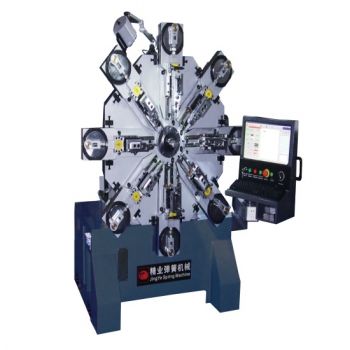
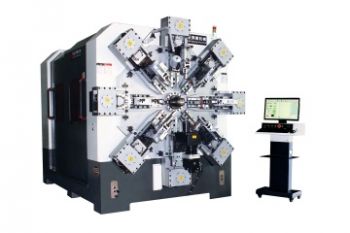
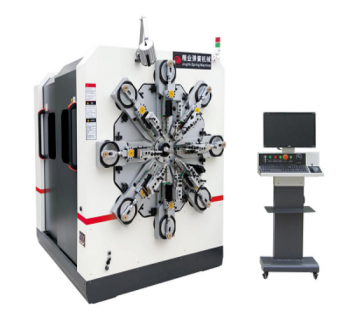
Manufacturers producing springs and formed-wire components can also use specialized CNC spring machines and CNC wire forming equipment to automate production.
Hydraulic Bending Machine Applications
Hydraulic bending machines are particularly suitable for applications involving large and heavy materials.
Common applications include:
Heavy steel plate bending
Structural steel fabrication
Construction components
Heavy machinery frames
Large chassis
Shipbuilding
Infrastructure components
For applications where high bending force is the primary requirement, hydraulic technology remains an effective solution.
How to Choose the Right Bending Machine
Selecting the right machine requires more than comparing the purchase price. Manufacturers should evaluate the material, product design, production volume, accuracy requirements, and long-term production goals.
1. Consider the Material
If you mainly process thick and rigid steel materials, a hydraulic bending machine may be more suitable because of its high force capacity.
If you manufacture wire products or precision formed components, a CNC wire bending machine may provide greater flexibility.
2. Consider Product Complexity
For products requiring multiple bends and complex three-dimensional shapes, a 3D CNC wire bending machine can be a strong choice.
For simpler two-dimensional wire components, a 2D wire bending machine may be sufficient.
3. Consider Production Volume
High-volume manufacturing can benefit from CNC automation because automated forming can improve productivity and reduce manual operations.
4. Consider Product Variety
If you frequently change between different products, CNC technology offers an important advantage. Different production programs can be stored and reused, helping reduce changeover time.
5. Consider Total Production Cost
The lowest purchase price does not necessarily mean the lowest manufacturing cost.
When evaluating equipment, manufacturers should also consider labor requirements, production speed, changeover time, material waste, maintenance, and expected production volume.
Why Choose CNC Wire Forming Technology?
As manufacturers increasingly focus on automation, production efficiency, and flexible manufacturing, CNC wire forming technology provides an effective solution for producing complex wire components.
A modern CNC wire forming machine can help manufacturers:
Improve product consistency
Increase production efficiency
Reduce manual operations
Produce complex wire shapes
Reduce operator-related errors
Handle multiple product specifications
Improve production flexibility
For companies producing springs, brackets, clips, frames, and other formed-wire products, the right CNC forming equipment can become an important part of an efficient automated production line.
CNC or Hydraulic Bending: Which Should You Choose?
There is no universal answer because the best machine depends on the application.
A CNC wire bending machine is generally a better choice when you need:
High precision
Excellent repeatability
Complex wire shapes
Automated production
Flexible product changeovers
High production efficiency
Multiple product specifications
A hydraulic bending machine may be more suitable when you need:
High bending force
Thick material processing
Heavy-duty production
Large components
Straightforward operation
A lower initial investment
If your primary products are wire forms, springs, brackets, clips, or other precision wire components, CNC wire forming technology deserves particular consideration.
Frequently Asked Questions
What is a CNC wire bending machine?
A CNC wire bending machine is an automated machine that uses computer-controlled programs to bend wire into specified shapes. It provides high repeatability, precision, and production flexibility.
What is the difference between a CNC bending machine and a hydraulic bending machine?
CNC bending machines rely on computer-controlled operation and are generally designed for precision, automation, flexibility, and repeatability. Hydraulic bending machines use hydraulic pressure to generate high bending force and are particularly suitable for thick and heavy materials.
Is a 3D CNC wire bending machine better than a 2D wire bending machine?
Neither is universally better. A 3D CNC wire bending machine is designed for three-dimensional and more complex wire forms, while a 2D wire bending machine is more suitable for products formed primarily in a flat plane.
What industries use CNC wire bending machines?
CNC wire bending machines can be used in automotive, electronics, aerospace, general manufacturing, and wire-product manufacturing applications.
Can CNC wire bending machines be used for spring production?
Specialized CNC spring machines are designed specifically for spring manufacturing. CNC wire forming equipment can also be used for many other formed-wire products, depending on the machine configuration and product requirements.
What should I consider before buying a CNC wire bending machine?
Important factors include wire diameter or material specifications, product complexity, required production speed, accuracy, automation level, tooling requirements, production volume, and product variety.
Conclusion
CNC wire bending machines and hydraulic bending machines serve different manufacturing needs.
Hydraulic bending machines remain an effective choice for heavy-duty applications requiring substantial bending force and robust operation.
For manufacturers focused on precision wire forming, complex components, flexible production, and automation, CNC wire bending machines offer significant advantages in accuracy, repeatability, productivity, and flexibility.
Depending on the product requirements, manufacturers can select from solutions such as 2D wire bending machines, 3D CNC wire bending machines, CNC wire forming machines, and CNC spring machines.
The right choice ultimately depends on your material, product design, production volume, accuracy requirements, and long-term manufacturing goals.
Looking for a CNC wire bending machine for your production line? Contact JYBending to discuss your wire forming requirements and find the right machine solution for your application.
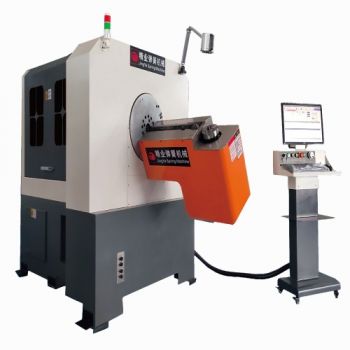
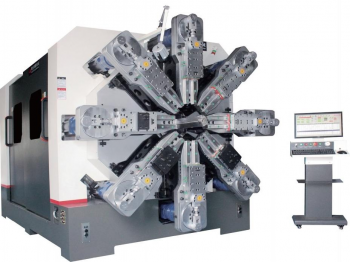
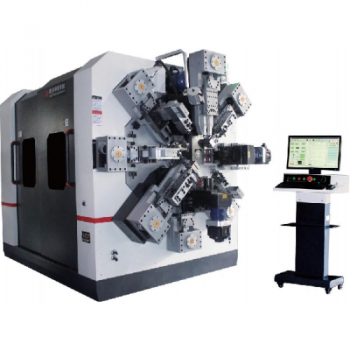
JY412 - 12R CNC Wipe Blade Bending Machine
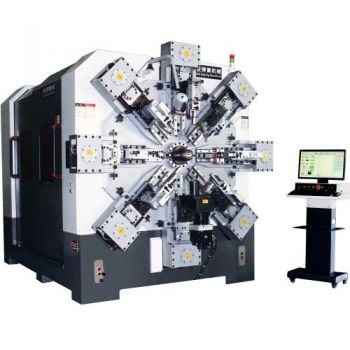
JY100-12R CNC Spring Machine Wire Rotation 12 axis multi-function
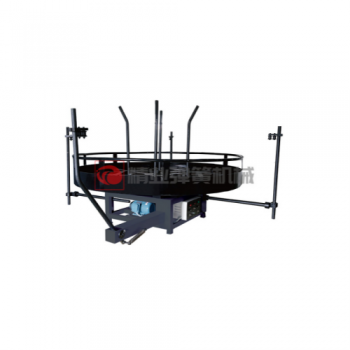
JY-1500 Wire Feeding Machine
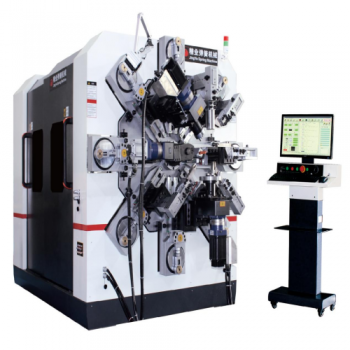
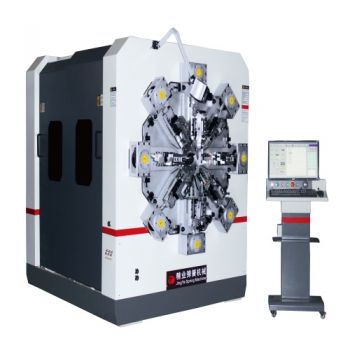
JY50-12R CNC Wire Rotation Bending Machine / Spring Machine
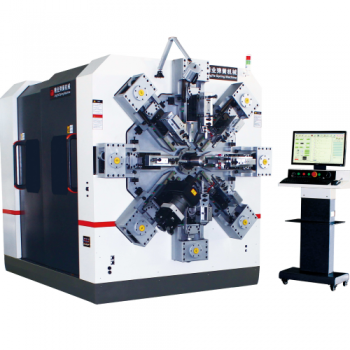
JY80-12R CNC Wire Rotation Spring Machine