Expert Spring Machine Factory - Recruit Distributor
Why more and more people use camless spring-making machines? Are traditional cams machine being phased out?
In the manufacturing sector for hardware springs, specialized shrapnel for new energy vehicles, and precision compression and extension springs, many factories still utilize traditional cam-driven spring machines. However, in the past two years, customers establishing new factories or upgrading production lines have almost exclusively opted for fully servo-driven, cam-free spring machines. What exactly gives servo models the edge in spring manufacturing? Today, we compare the traditional cam structure with the fully servo-controlled system to understand the underlying logic driving this industry upgrade.
Traditional Cam Spring Machines In the past, when spring manufacturing orders were uniform and precision requirements were lenient, cam spring machines relied on mechanical cam transmissions; changing the forming path required swapping out cam plates. While they met basic mass-production needs, they suffered from inherent, unavoidable flaws: 01 Extremely time-consuming setup changes: Producing a new spring model required dismantling the machine head, regrinding parts, and replacing cams. In a "high-mix, low-volume" production environment, the majority of production time was wasted on changeovers. 02 Significant mechanical wear and declining precision: Long-term friction within purely mechanical structures—such as cams and gears—led to accumulated backlash and dimensional tolerance drift. Frequent recalibration was required, and the machines were highly prone to producing defects when manufacturing precision springs for the new energy sector. 03 High operational barrier and recruitment challenges: Cam paths relied entirely on the operator's experience and intuition; it took newcomers at least six months to become proficient. With the current shortage of skilled manufacturing workers, labor costs continue to rise. 04 Limited product capabilities and difficulty with complex springs: Due to the stroke limitations of mechanical cams, many designs—such as parts with multiple bends, complex angles, or multi-stage forming requirements—simply could not be produced. Cam Structure in Spring-Making Machines
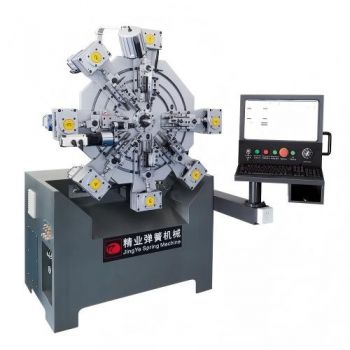
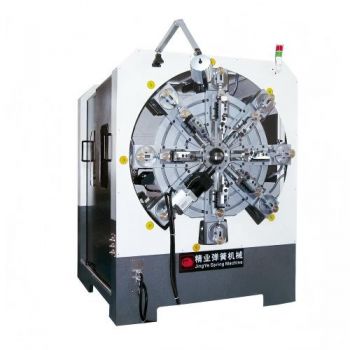
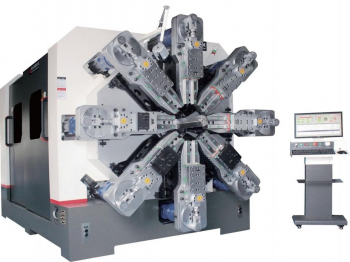
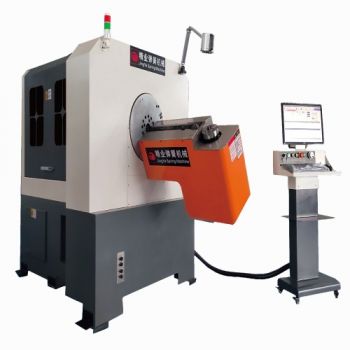
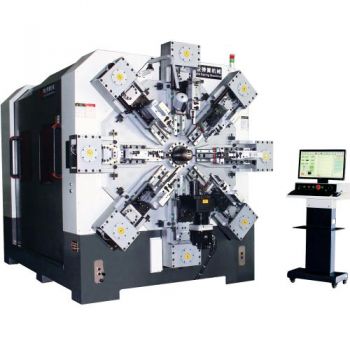
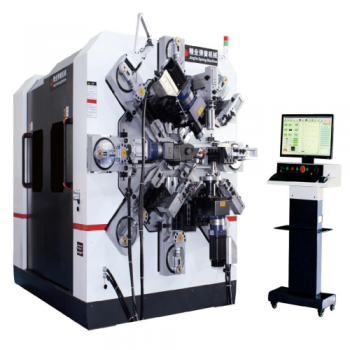
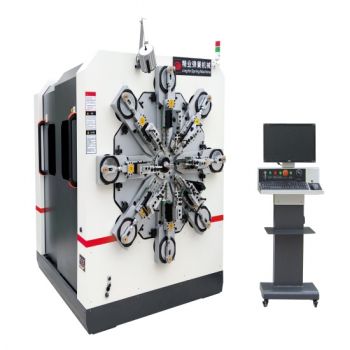
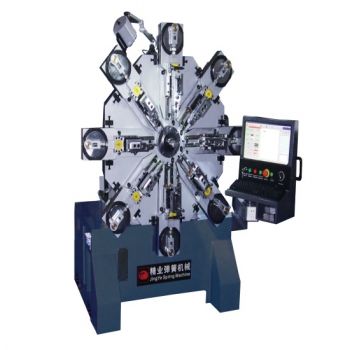
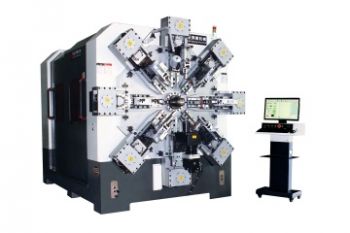
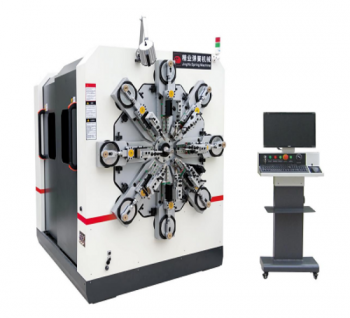
Fully Servo-Driven Spring Machine This fully servo-driven, cam-free model eliminates the traditional mechanical cam structure. Each forming tool axis, wire-feeding axis, and wire-rotating axis is driven by an independent servo motor. A CNC system precisely controls the speed, angle, and travel of every axis, addressing key industry pain points with four major advantages: 01 Stable processing precision and significantly higher yield rates: Servo motors enable pulse-level positioning accuracy with zero mechanical backlash between axes, ensuring highly consistent dimensions in mass production. It is ideal for demanding products such as battery contact springs for new energy vehicles, precision automotive springs, and micro-springs for medical devices. Precision remains stable during long-term production, drastically reducing rework and material waste. 02 Doubled setup efficiency and a short learning curve for new operators: There is no need to disassemble cams or grind parts; all spring-forming parameters are entered digitally via a touchscreen. Once parameters are input, the system automatically generates the motion program. 03 Rapid model switching, ideal for high-mix, low-volume orders: Designed to handle the industry norm of small, urgent, and varied orders, the servo-driven machine stores multiple product programs. Switching models requires only a one-touch recall of saved parameters—eliminating the need for repeated mechanical adjustments—so small and medium-sized factories do not need to maintain separate production lines for different product types. 04 Simplified programming and versatile processing of complex, irregular springs: Independent multi-axis servo control supports synchronous or asynchronous movement at any angle. Complex irregular springs, double-layer extension/compression springs, snap-fit clips, and energy-storage conductive springs can all be formed in a single pass. The system includes a built-in graphical simulation feature, allowing users to preview the forming result before programming to avoid trial-and-error and material waste.